Time-Tested. Quietly Modernized.

Braces have been straightening smiles for nearly a century, and there's a reason they're still the most common orthodontic treatment in America. They work. They handle simple cases and complex ones with equal skill, and they don't depend on the patient remembering to put them in every morning.

What's changed in the last 20 years: the brackets are smaller, the wires use modern shape-memory alloys that move teeth more gently, and adjustment visits are shorter. Dr. Rodney Torres works with both metal and ceramic braces at our Tampa and Miami Lakes offices, and will help you choose the one that fits your smile and your life.

Your first visit is always a free smile exam, with no obligation to commit to anything.

Close-up of modern orthodontic braces

The Most Versatile Treatment in Orthodontics

Aligners have a place, but for the widest range of cases (and for patients who don't want to depend on daily compliance), braces are still the right answer.

Proven for Every Case

From mild crowding to complex bite issues, braces handle a wider range of cases than any other orthodontic treatment. If a smile needs work, braces can do it.

Smaller, Smoother, Smarter

Today's brackets are about half the size of the ones your parents wore, with rounded edges that don't catch on the inside of your lip. The wires are gentler too.

Steady Progress, No Guesswork

Braces stay on and work 24/7. You can't lose them, you can't forget to wear them, and you can't accidentally skip a few days. Treatment moves forward on its own.

Two Looks, One Result

Choose traditional metal brackets or tooth-colored ceramic ones. The same proven technology underneath, just a different look on top.

Metal or Ceramic? Both Work.

Same proven mechanics underneath. The choice comes down to look, budget, and how visible you want the treatment to be.

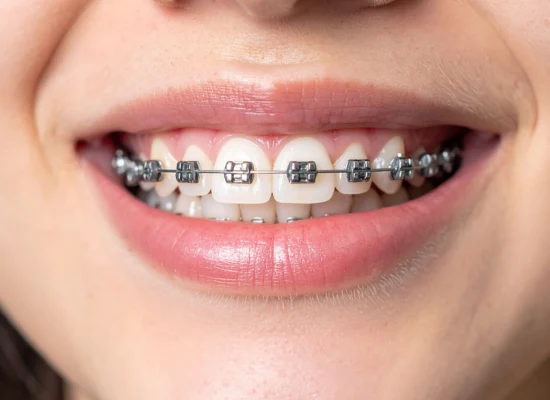
Close-up of traditional metal braces
The classic, and the most affordable.

Metal Braces

Stainless steel brackets bonded to each tooth, connected by a thin archwire. Today's brackets are smaller, smoother, and more comfortable than what your parents wore. Metal is the most affordable option and handles the widest range of cases.

Good for:
  • Any case, from simple to complex
  • Budget-conscious families
  • Kids and teens who like changing colored bands every visit
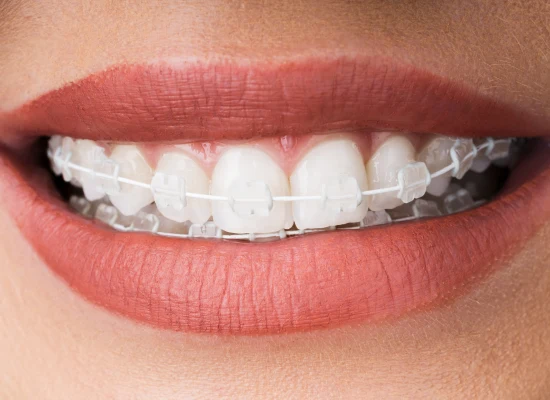
Close-up of tooth-colored ceramic braces
The discreet option.

Ceramic Braces

Tooth-colored brackets work the same way as metal but blend in with your teeth. The wires are still visible, but the brackets nearly disappear. A bit more expensive than metal, and the elastic ties can stain with heavy coffee, but most patients prefer the look.

Good for:
  • Adults who want a subtler appearance
  • Teens who feel self-conscious about metal
  • Patients in roles where visible braces feel awkward

The Wide Range of Cases Braces Handle

Braces are the most versatile orthodontic treatment available. They handle bite issues that aligners can't always touch, and they work for kids, teens, and adults alike.

  • Crooked, twisted, or rotated teeth
  • Crowding when there isn't enough space for everything
  • Gaps and uneven spacing
  • Overbite, where top teeth cover the bottom too much
  • Underbite, where bottom teeth sit in front of the top
  • Crossbite, where top and bottom don't line up correctly
  • Open bite, where the front teeth don't meet when biting down
  • Jaw alignment issues that affect chewing or comfort

Your Free Smile Exam

The first visit is about giving you a clear picture and honest answers. Here's what we cover in about an hour.

  • A quick digital iTero scan, no goopy impressions
  • Honest review of metal vs ceramic for your case
  • A realistic treatment timeline with milestones
  • Insurance verification and a written estimate, all before you commit

Common questions about braces from Tampa and Miami Lakes patients. Don't see yours? Call our Tampa office at (813) 920-7720 or our Miami Lakes office at (786) 319-9057.

Common Questions About Braces

How long does treatment with braces take?
+
Most braces treatment runs 12 to 24 months, depending on how complex the case is. Simple alignment can finish in 6 to 9 months. More involved bite corrections can take 24 to 30 months. Dr. Torres will give you a personalized timeline at your free smile exam.
Do braces hurt?
+
Not really. There's some pressure and tenderness for a day or two after each adjustment as the teeth start to move, but it fades quickly. Over-the-counter pain relief takes care of it. Most patients say the first week is the most noticeable, and after that the visits are uneventful.
What foods do I need to avoid with braces?
+
Hard, sticky, and chewy foods are the main ones to skip. Popcorn kernels, ice, hard candy, caramel, taffy, gum, and whole apples (slice them first). Bagels, hard pretzels, and tough cuts of meat are worth avoiding too. Most other foods are fine.
How often will I have appointments?
+
Adjustment visits are every 4 to 8 weeks, depending on where you are in treatment. Each visit takes about 20 to 30 minutes. We do our best to schedule around school, work, and sports.
Can my child play sports with braces?
+
Yes. We'll fit a custom orthodontic mouthguard for any contact or helmet sport (football, basketball, lacrosse, hockey, soccer). The mouthguard protects the brackets and the inside of the mouth from impact.
Will I need a retainer after braces come off?
+
Yes. Retainers keep your teeth in their new positions after the brackets come off. Without one, teeth tend to drift back over time. We'll fit you for a retainer the same day the braces come off, and Dr. Torres will explain how often to wear it.

Ready for Your Best Smile?

Schedule a free smile exam at the office closest to you. Dr. Torres will tell you honestly whether braces are the right fit and walk you through what treatment would look like.